Fasting Tracker
A fasting notebook that tracks weight, blood pressure, heart rate and blood sugar, and says when a reading falls outside the usual range.
Going a day or more without food moves your body faster than memory keeps up with. Weight, blood pressure, resting heart rate and blood sugar all shift, and by the second morning what you think you measured yesterday is not worth trusting. Most people fasting on their own end up with a few numbers in a memo app and no sense of which one mattered.
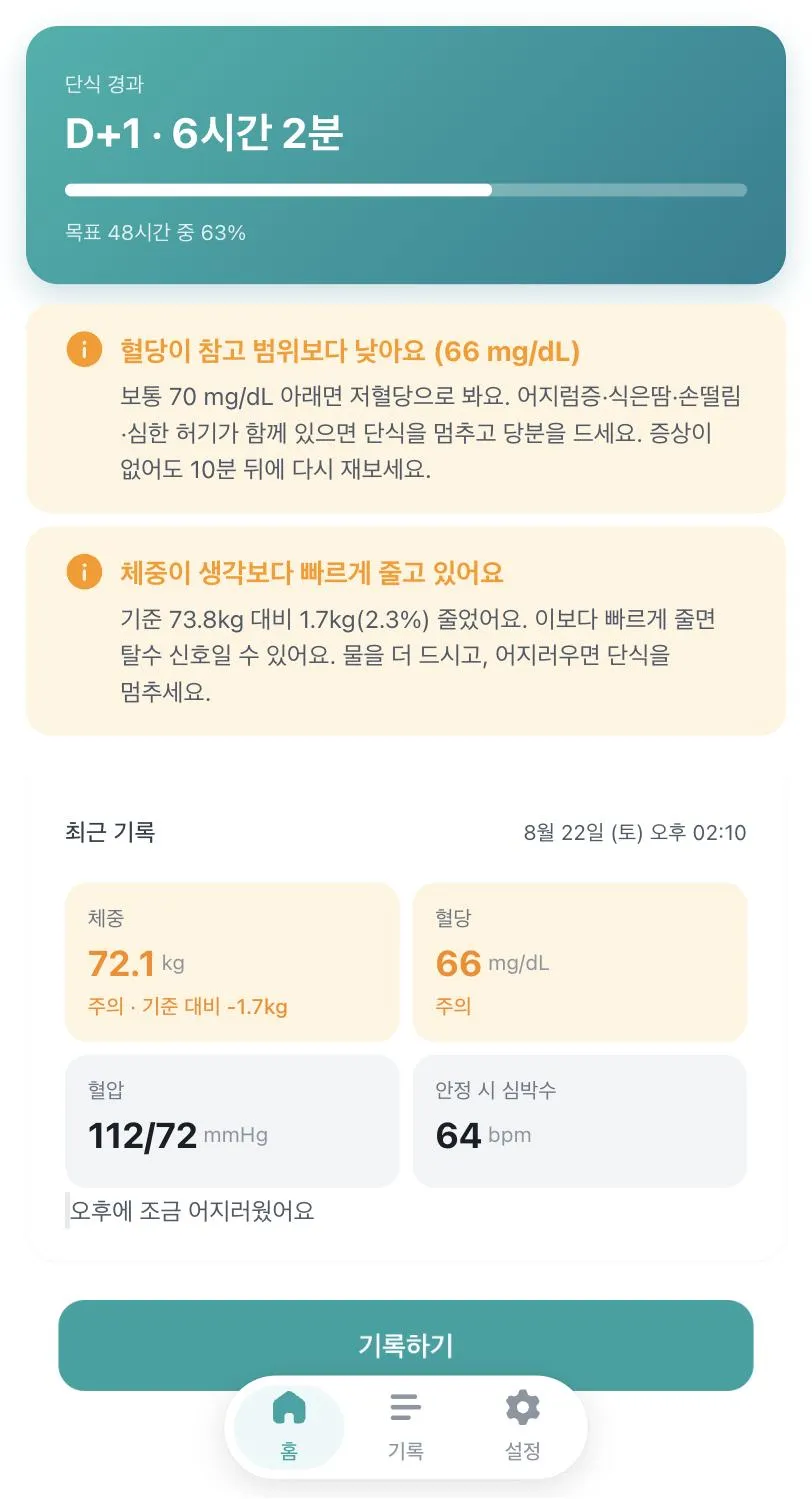
Fasting Tracker is a notebook for that stretch, running as a Toss Mini App. You log a reading when you actually take one, add a line about how you feel, and the app keeps the running clock, the change since you started, and a chart per metric. When a value lands outside the usual reference range, it says so in plain words, gives the range it is comparing against, and tells you what would be worth doing about it.
How it works
- Start a fast. Choose the kind (water fast, intermittent, other), when it began, and how long you are aiming for. The clock on the home screen runs from there.
- Log what you measured. Weight, blood pressure, resting heart rate, blood sugar, a memo. Only the fields you actually took, and previous values are never pre-filled, so yesterday’s number cannot be saved as this morning’s.
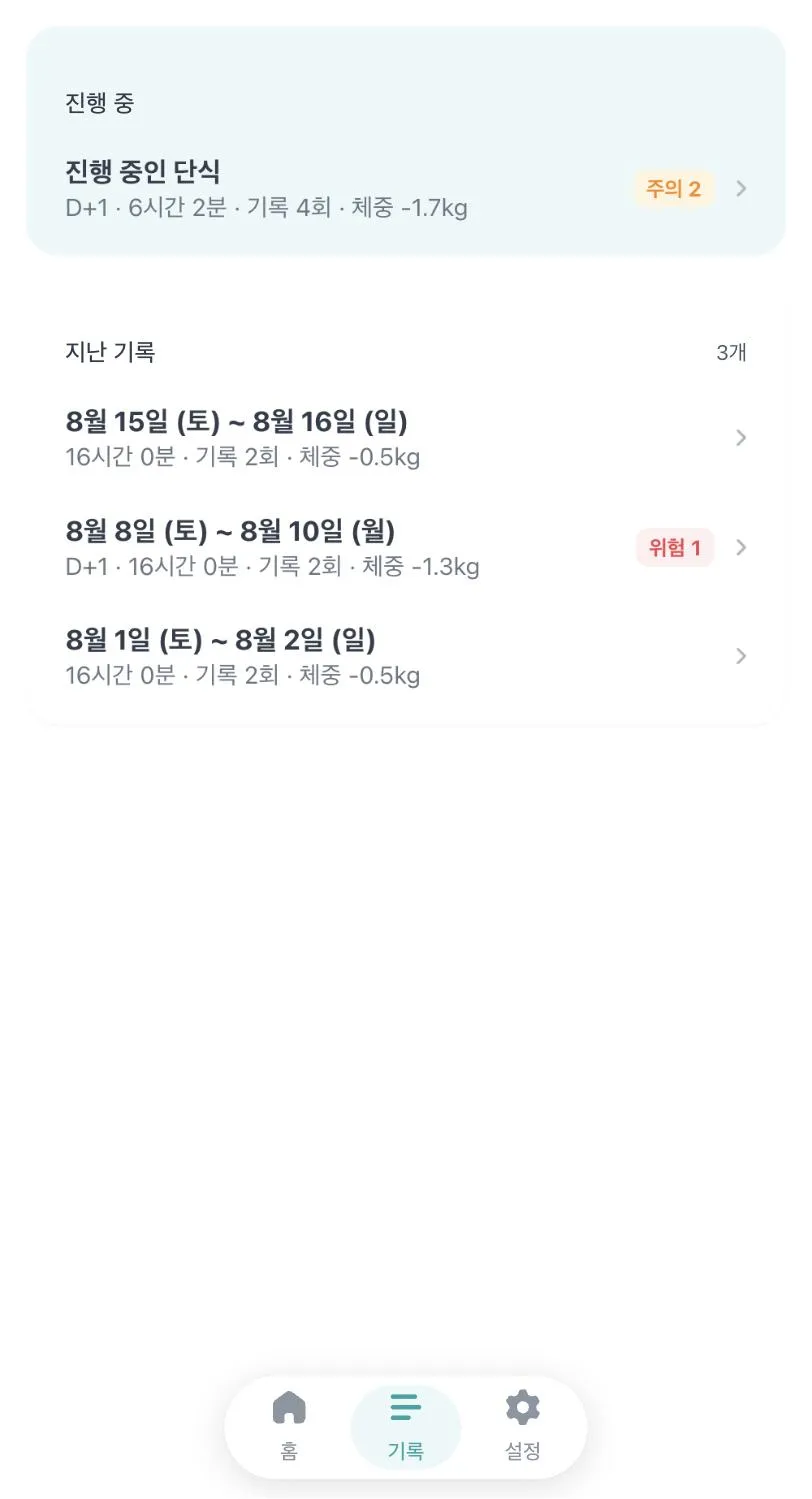
- Watch it move. The history tab keeps every fast with the change since its first reading, a chart for each metric, and out-of-range entries marked in both.
Features
- Out-of-range readings are flagged with the reason. Blood sugar under 70 mg/dL gets a card naming the threshold, the symptoms that would mean stopping, and a prompt to measure again in ten minutes. It is information about a number, not a diagnosis.
- Weight is judged by rate, not by one fixed line. A water fast drops mostly water in the first days, so a cumulative percentage flags a perfectly normal curve. Water fasts are checked against a daily rate; intermittent fasts against the change since the start.
- Nothing leaves the phone. Records sit in the app’s own storage on your device. No account, no sync, no server holding your blood pressure. Usage events the app sends back carry no measurements and no memos.
- Logging takes seconds. The form opens as a sheet over the home screen, so a reading does not cost you a trip through tabs.
- Old fasts stay browsable. Each finished fast keeps its dates, entry count, weight change, and how many alerts fired during it.
- Ending a long fast comes with a warning. Stop after three days or more and the app surfaces refeeding guidance before you eat, since that is where a fast most often goes wrong.
FAQ
What do I need to run it? Toss, the Korean financial app, on iOS or Android. Fasting Tracker is a Toss Mini App: there is nothing to install separately, and no web address either, which is why this page has no button to open it. Inside Toss, search for 단식수첩. The interface is Korean only, so if you do not use Toss, this one is not available to you.
Is it a medical device? No. The alerts compare what you typed against published reference ranges and tell you when it falls outside one. That is not a diagnosis, and no alert does not mean you are fine. Electrolyte imbalance, refeeding syndrome, low sodium and orthostatic hypotension do not show up in these four numbers at all. Anything that worries you belongs with a doctor, not an app.
Who should not use it? Anyone who should not be fasting unsupervised in the first place. The app opens with that list: pregnancy and breastfeeding, eating disorders, low body weight, impaired liver or kidney function, hyperthyroidism, and anyone on insulin, diabetes medication, blood pressure drugs or diuretics.
Where do my records live? On the phone, in the app’s own storage. Nothing is uploaded, which also means nothing is backed up: delete Toss and the records go with it. There is no export yet, so treat it as a notebook you could lose rather than an archive.
Does it cost anything? No, and there is no account to make. That is where things stand today rather than a promise about next year. If it ever changes, this page will say so before it does.